
Learn
The art of ballroom dance
Musicality, character, and expression — why the rumba is a love story, the paso doble a bullfight, and why the best dancing leaves only feeling.
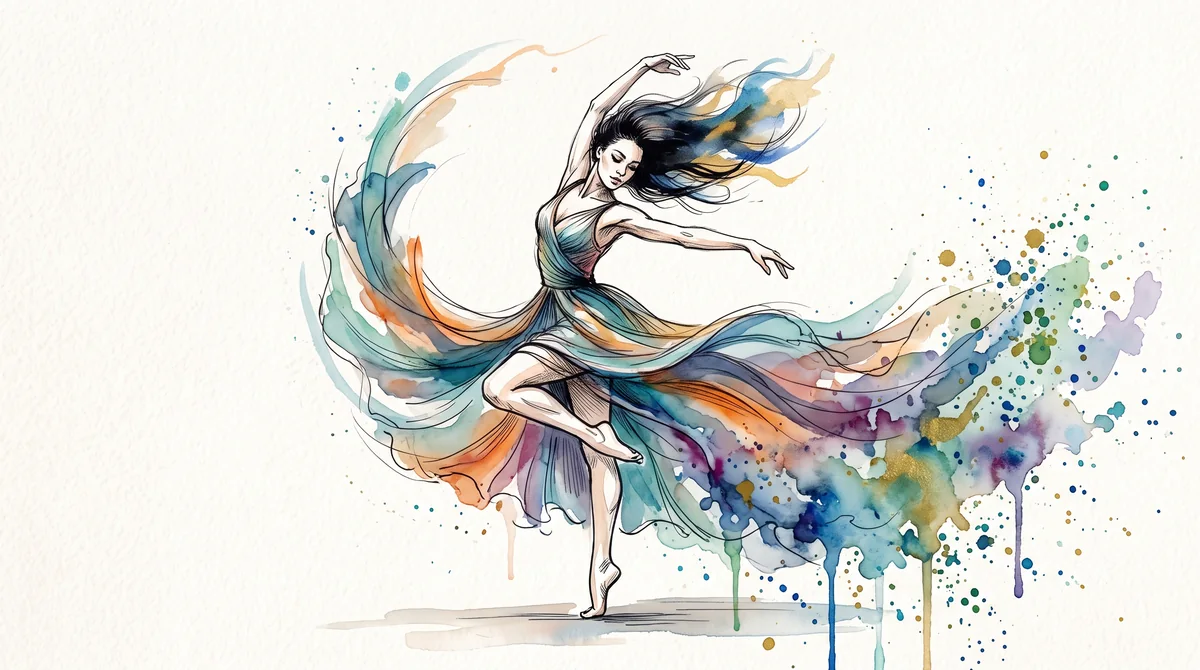
Strip away the rhinestones and the scoresheets and what remains is art: bodies interpreting music, partners telling a story together, and a different character for every dance. This is the expressive heart of ballroom.
Interactive · The character of each dance
Standard & Smooth
Latin & Rhythm
Rise and fall like a slow breath — romance, grace, and endless flowing turns.
Competition tempos are approximate and vary slightly by federation. MPM = measures (bars) per minute.
Interactive · Hear the rhythm
Standard & Smooth
Latin & Rhythm
A clear lift on beat 1, then float through 2 and 3 — the gentle rise-and-fall swing.
Tempos are competition guidelines and vary by federation. Slow it down to learn the timing, then build up to speed. MPM = measures (bars) per minute.
Dancing the music
Great dancing doesn’t just keep time — it interprets the music. Every dance has its own tempo and time signature, but the best dancers ride the melody, catch the accents, and let the phrasing shape their movement. Musicality is what separates steps performed from a dance truly danced.
Every dance, a story
Each dance carries a distinct character. The rumba is a slow tale of love; the paso doble casts one partner as a matador and the other as the cape; the Viennese waltz is pure romantic whirl; the tango is all drama and sudden stillness. Learning a dance means learning to inhabit its mood — to mean it.
Expression & performance
Beyond the steps, ballroom is performance — line, shaping, and the connection between partners and with an audience. Costume, poise, and presence turn technique into something that moves people. The very best dancers make difficulty disappear and leave only feeling.
Art and sport, together
Ballroom is rare in being judged as both athletics and art. The same routine that demands an athlete’s fitness asks for an artist’s expression — and that union is exactly what makes it so captivating to dance and to watch.
Common questions
- What is musicality in dance?
- Dancing that interprets the music rather than just keeping time — riding the melody, catching the accents, and letting the phrasing shape the movement. It's what separates steps performed from a dance truly danced.
- What story does each ballroom dance tell?
- Each carries its own character: the rumba is a slow tale of love, the paso doble casts one partner as a matador and the other as the cape, the Viennese waltz is pure romantic whirl, and the tango is all drama and sudden stillness.
Continue learning
The History
From Renaissance courts to the Olympic stage — five centuries of the art form, and the people who shaped it.
Read →The Sport
Heart rates over 170, a century-old scoring system, and the road from Bronze to Championship — the athletic case for dance.
Read →Health & Wellness
A 76% lower dementia risk, a stronger heart, better balance — what the research says dance does for every age.
Read →Dance in Schools
Why ballroom belongs in every classroom — the programs reaching kids today, and the gap we want to help close.
Read →Sources
- Ballroom dance (styles, dances & tempos) — Wikipedia
- History of Modern Ballroom — Imperial Society of Teachers of Dancing