

Learn
The history of ballroom dance
From Renaissance courts and the scandalous waltz to Harlem's Lindy Hop and the Olympic stage — five centuries of ballroom history in one story.
Ballroom dance began in the royal courts of Renaissance Italy and France and grew, over five centuries, into a global competitive sport. Along the way it became a mirror of human society — class boundaries dissolving, European, African, and Latin American traditions fusing on the dance floor, and the simple, enduring urge to move together to music.
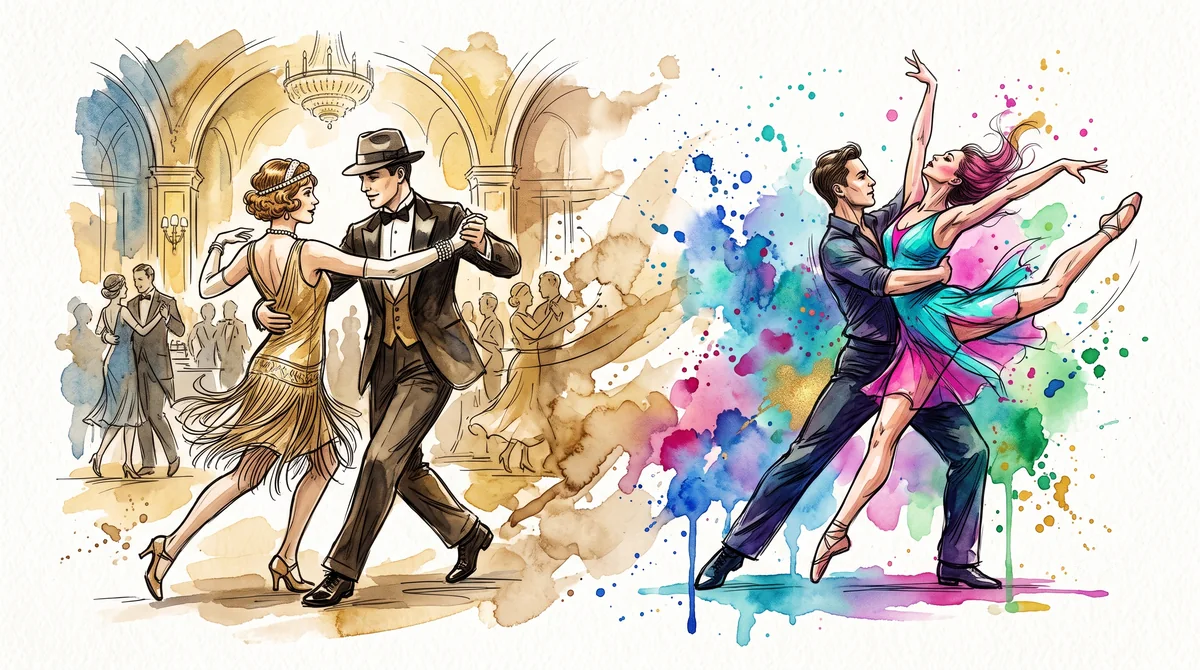
Interactive · A short history
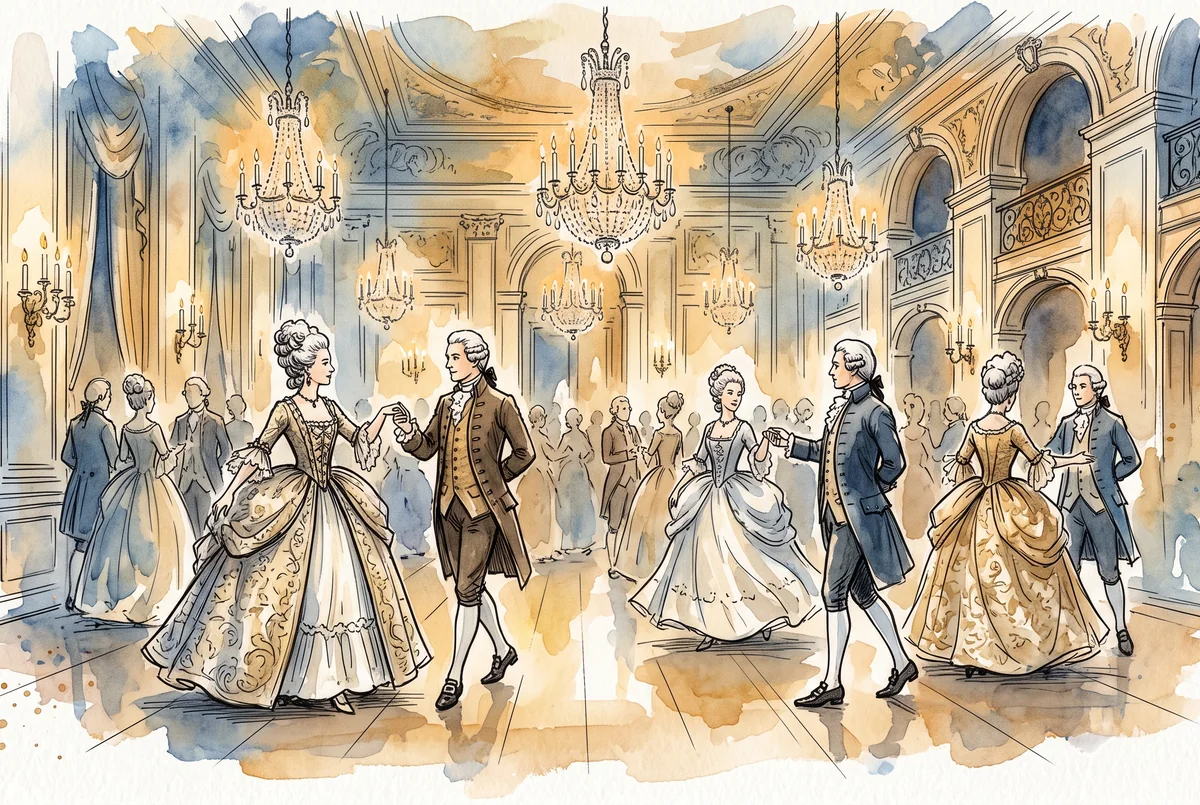
The waltz arrives
The waltz swept out of Vienna and scandalized polite society — its close hold was thought shocking, even “riotous and indecent.” Within a few decades it was the most fashionable dance in Europe.
Infographic · Roots of the dances
The modern ballroom is a fusion of three great streams — European court traditions, the music of Latin America and the Caribbean, and African-American innovation.
Europe's courts & ballrooms
- Waltz — Austria & Germany
- Viennese Waltz
- Quickstep — England
- Slow Foxtrot
- Paso Doble — Spain & France
Latin America & the Caribbean
- Rumba · Cha-Cha · Mambo · Bolero — Cuba
- Samba — Brazil
- Tango — Argentina
African-American innovation
- Lindy Hop — Harlem, New York
- Swing & Jive
- The rhythmic drive behind modern Latin
Three streams · one ballroom — the modern ten-dance canon
Born in the courts (1400s–1700s)
The word ballroom comes from the Latin ballare, “to dance.” The earliest ancestors of ballroom appeared in the royal courts of Italy and France in the 15th and 16th centuries, where dance was a formal display of etiquette and rank. In 1588 the Frenchman Thoinot Arbeau documented the era’s dances — the gliding basse danse, the lively branle, the leaping galliarde — in his treatise Orchésographie.
Under Louis XIV, dance was codified: he founded the Académie Royale de Danse in 1661, where the five positions of the feet were first written down, and the stately Minuet, set to Lully’s music, ruled European ballrooms until the close of the 18th century. These early dances kept partners at a dignified arm’s length.
The waltz revolution (1800s)
The 19th century brought a scandal that changed everything: the closed couple hold. Evolving from the Austrian and German folk Ländler, the waltz (from walzen, “to revolve”) had partners embrace and spin rapidly around the room. Moralists called it risqué; doctors warned the spinning was dangerous — and the controversy only made it irresistible.
The Strauss family, above all Johann Strauss Jr., the “Waltz King” of The Blue Danube, turned it into a craze, and grand public dance halls let the classes mingle as never before. The Polka, Mazurka, and Galop soon followed.
The golden age (1910s–1920s)
Ragtime and early jazz set off a burst of energetic new dances. From them came the Foxtrot, named around 1914 for vaudevillian Harry Fox — and refined by the glamorous Vernon and Irene Castle, who made the new dances smart and wholesome. Irene became a fashion icon whose bobbed hair and unrestrictive dresses freed women from Victorian corsets, and the Castles insisted on performing with African-American musicians, helping break down racial barriers.
At the same time the Argentine Tango — born in the immigrant neighborhoods of Buenos Aires and Montevideo — swept Paris and London into “tango mania,” surviving bans from a Kaiser and a Pope to reach worldwide fame.
The English style (1920s–1930s)
With so many new steps, English teachers moved to standardize. In 1924 the Imperial Society of Teachers of Dancing formed a Ballroom Branch — with figures like Josephine Bradley and Victor Silvester — and by 1929 the Official Board of Ballroom Dancing had fixed the steps, tempos, and technique of the “Standard Four”: Waltz, Foxtrot, Tango, and Quickstep.
This “English Style” is still the basis of International Standard today. Tellingly, even the Standard Waltz’s signature body sway was borrowed from the Cuban Rumba — an early sign of how deeply Latin and African rhythms would shape the ballroom.
African & Latin roots
If European courts shaped the Standard dances, the Rhythm and Latin dances were shaped by the African diaspora and Latin America. In 1920s–30s Harlem, the Lindy Hop was born in the Savoy Ballroom — an African-American innovation of acrobatic “air steps” and dazzling improvisation, named for aviator Charles Lindbergh’s “hop,” that grew into Swing and Jive.
The Rumba evolved from the music of enslaved Africans in Cuba into a slow, sensual dance defined by continuous “Cuban motion.” From the Mambo, bandleader Enrique Jorrín built the Cha-Cha-Cha in the early 1950s. Brazil gave the festive, bouncing Samba; Spain and France gave the dramatic Paso Doble, which casts one partner as a proud matador and the other as the sweeping red cape.
A global sport (post-war to today)
After the war, ballroom split into two worlds: social recreation and competitive Dancesport, governed today by the World Dance Council and the World DanceSport Federation. Its most storied stage, the Blackpool Dance Festival, has filled the Empress Ballroom since 1920.
Hollywood’s Fred Astaire and Ginger Rogers made partner dancing pure glamour; in our own century, Strictly Come Dancing and Dancing with the Stars brought it back to millions — and breaking carried dancesport onto the Olympic stage.
The “Standard Four” became a global canon
What began as four standardized dances grew into the modern ten-dance canon — five Standard and five Latin — danced on competition floors around the world. Each one carries its own tempo, character, and story.
Common questions
- Where did ballroom dancing originate?
- In the royal courts of 15th- and 16th-century Italy and France, where dance was a formal display of etiquette and rank. The word ballroom comes from the Latin ballare, 'to dance.'
- Why was the waltz considered scandalous?
- It introduced the closed couple hold — partners embracing and spinning rapidly around the room. Moralists called it risqué and doctors warned the spinning was dangerous, and the controversy only made it irresistible.
- When was ballroom dance standardized?
- In 1920s London. The Imperial Society of Teachers of Dancing formed its Ballroom Branch in 1924, and by 1929 the 'Standard Four' — Waltz, Foxtrot, Tango, and Quickstep — had fixed steps, tempos, and technique.
- What are the ten dances of dancesport?
- Five Standard — Waltz, Tango, Viennese Waltz, Foxtrot, and Quickstep — and five Latin — Cha-Cha, Samba, Rumba, Paso Doble, and Jive.
Continue learning
The Sport
Heart rates over 170, a century-old scoring system, and the road from Bronze to Championship — the athletic case for dance.
Read →The Art
Musicality, expression, and the distinct character of Standard, Latin, Smooth, and Rhythm.
Read →Health & Wellness
A 76% lower dementia risk, a stronger heart, better balance — what the research says dance does for every age.
Read →Dance in Schools
Why ballroom belongs in every classroom — the programs reaching kids today, and the gap we want to help close.
Read →