

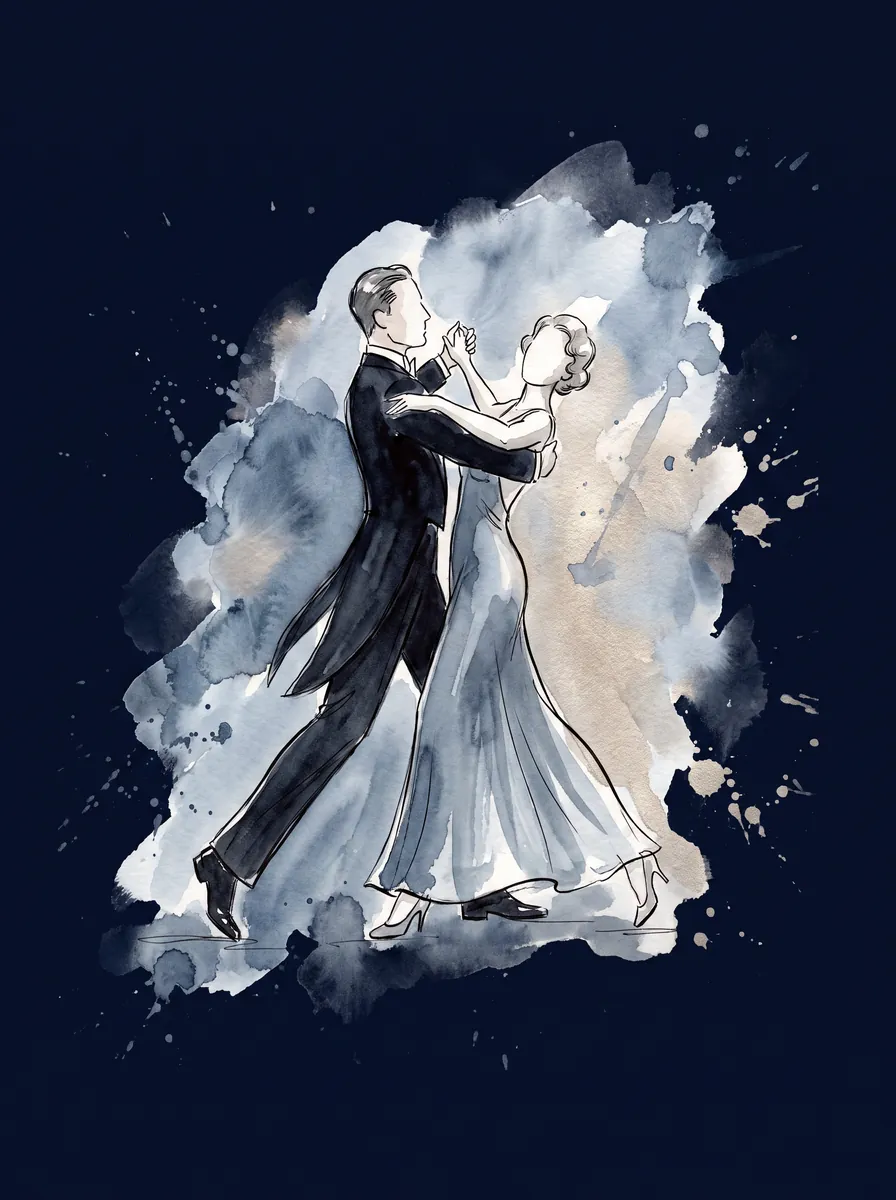
Where it comes from
The foxtrot arrived with ragtime. Named around 1914 for the vaudevillian Harry Fox, it was refined by Vernon and Irene Castle — the celebrity couple who made the new jazz-age dances smart and wholesome, insisted on performing with African-American musicians, and helped free women's fashion from the corset along the way.
A century on, it's the dance most people picture when they hear “ballroom”: Fred Astaire's black-tie glide, unhurried and impossibly smooth. Dancers often call it the hardest of the Standard dances to truly master — the slow tempo leaves every flaw in plain view.
How it moves
Foxtrot is the art of walking beautifully. Long, gliding steps in 4/4 time, counted in slows and quicks, with a rise and fall closer to a gentle wave than the waltz's breath. The goal is continuity — no visible effort, no bounce, just travel that never seems to begin or end.
- Feather step & three step — the classic opening pair
- Slow–quick–quick timing
- The gliding walk — long strides with no visible effort
- Fred Astaire's home dance
What to listen for
Smooth 4/4 with a soft stress on 1 and 3 — gliding, unhurried, sophisticated.
Test yourself — the Foxtrot rhythm challenge →What judges look for
Judges reward what is hardest: continuity. Smooth, powerful travel, soft timing, and no jolt between figures. Because nothing in a foxtrot is fast, nothing in a foxtrot is hidden.
Competition tempos are the widely used ranges and vary slightly by federation. New to scoring? Read how ballroom dance judging works.
Songs you can dance the Foxtrot to
Classics and pop staples with the Foxtrot's tempo and feel. Social DJs often run them a touch faster or slower than strict competition tempo — that's normal.
- Fly Me to the Moon — Frank Sinatra
- The Way You Look Tonight — Frank Sinatra
- L-O-V-E — Nat King Cole
- Cheek to Cheek — Fred Astaire
- It Had to Be You — Harry Connick Jr.
- Ain't That a Kick in the Head — Dean Martin
- Feeling Good — Michael Bublé
Also danced in American Smooth
The Foxtrot also appears in American Smooth, the American style danced widely in U.S. competition — same music and character, with its own technique and figures. The differences are covered in how dancesport works.
Common questions
- Why is it called the foxtrot?
- It's named for Harry Fox, a vaudeville performer whose trotting step to ragtime music caught on around 1914.
- Is the foxtrot hard to learn?
- The basics are friendly, but dancers often call it the hardest Standard dance to master — its slow, exposed tempo demands a control that faster dances can disguise.
- What's the difference between foxtrot and quickstep?
- Quickstep is the foxtrot's fast, playful sibling — born in the 1920s when bands played foxtrots too fast — with runs, hops, and skips the slower dance never uses.
Dance it
Learn the Foxtrot near you
1,280 studios across 69 countries teach the world's dances — or watch the Foxtrot competed at a sanctioned event.
The other nine
Which dance are you? Take the quiz · the art of ballroom dance · the history · the glossary