

Where it comes from
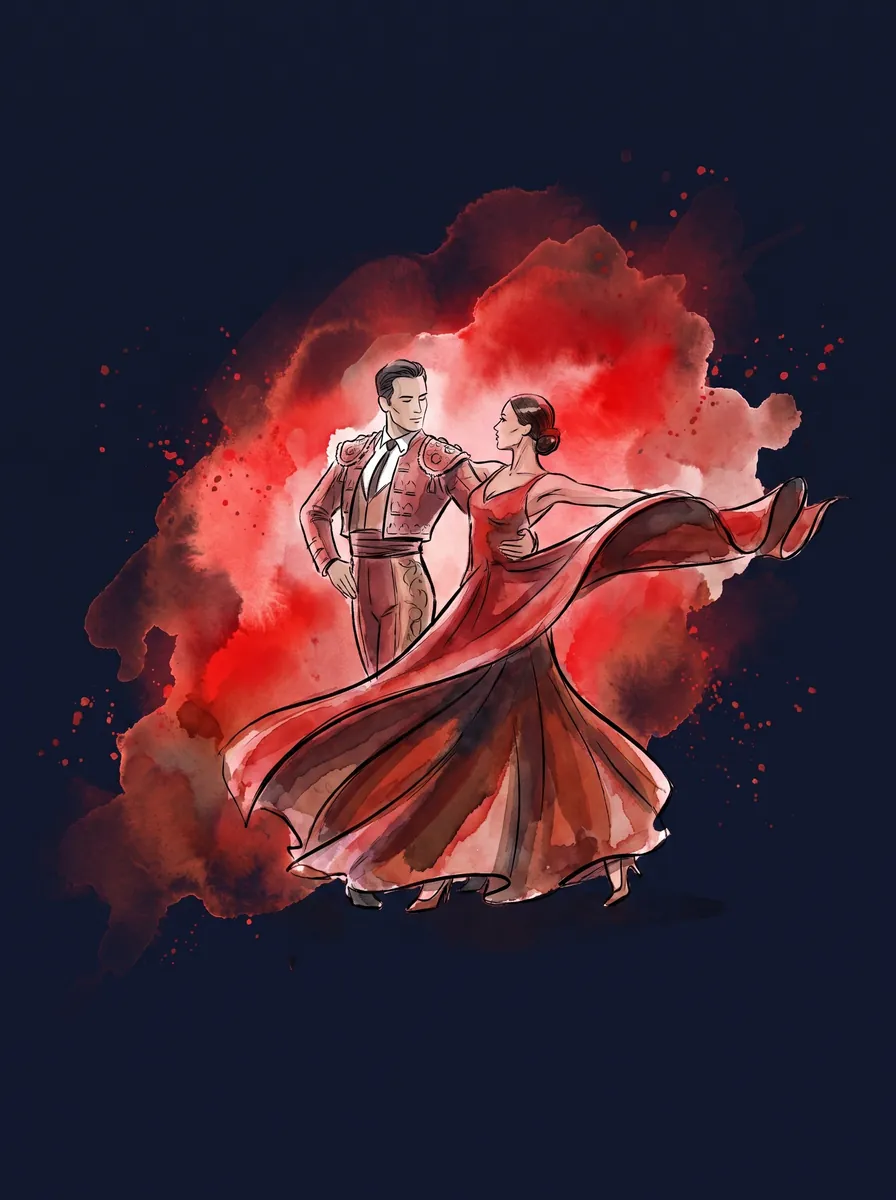
The paso doble comes from Spain and France, set to the march music of the bullring — the pasodoble played as the matador enters the arena. The dance casts its partners in the arena's roles: one the proud matador, the other the sweeping cape.
It is ballroom's piece of theatre — the one Latin dance whose story is fixed, whose music is a march, and whose biggest moments land on the score's dramatic crashes.
How it moves
Paso doble is danced in the body's proudest shape: lifted chest, drawn-back shoulders, weight carried forward like a matador's. It marches in 2/4 at sixty bars a minute, travels the floor, and builds its choreography toward the music's “highlights” — the crescendos of the traditional pasodoble score where the picture freezes. The cape work — chassé capes, the stamped apel that opens the story — makes the drama literal.
- Matador and cape — the fixed dramatic roles
- The apel — the stamped call that opens the story
- Chassé capes & promenades — the cape work
- Choreography built to the music's crashes
What to listen for
The march of the bullring — proud and driving, every beat a footfall.
Test yourself — the Paso Doble rhythm challenge →What judges look for
Judges reward shape and conviction — the lifted, arched matador line held while travelling — and musical architecture: routines that arrive at the highlights exactly as the score crashes.
Competition tempos are the widely used ranges and vary slightly by federation. New to scoring? Read how ballroom dance judging works.
Songs you can dance the Paso Doble to
Classics and pop staples with the Paso Doble's tempo and feel. Social DJs often run them a touch faster or slower than strict competition tempo — that's normal.
- España Cañí — Pascual Marquina Narro
- Malagueña — Ernesto Lecuona
- Amparito Roca — Jaime Texidor
- Y Viva España — Manolo Escobar
Common questions
- What story does the paso doble tell?
- The bullring's: one partner dances the proud matador, the other the sweeping cape. It's the one Latin dance whose drama is fixed in the choreography.
- Why does paso doble music sound the same at every competition?
- Most competitions play a traditional pasodoble — España Cañí is the classic — whose fixed crescendos let couples choreograph their highlights to the exact bar.
- Is the paso doble danced socially?
- Rarely — it lives almost entirely on the competition floor, and in many syllabi it arrives at the higher levels rather than in a first-year program.
Dance it
Learn the Paso Doble near you
1,280 studios across 69 countries teach the world's dances — or watch the Paso Doble competed at a sanctioned event.
The other nine
Which dance are you? Take the quiz · the art of ballroom dance · the history · the glossary