

Where it comes from
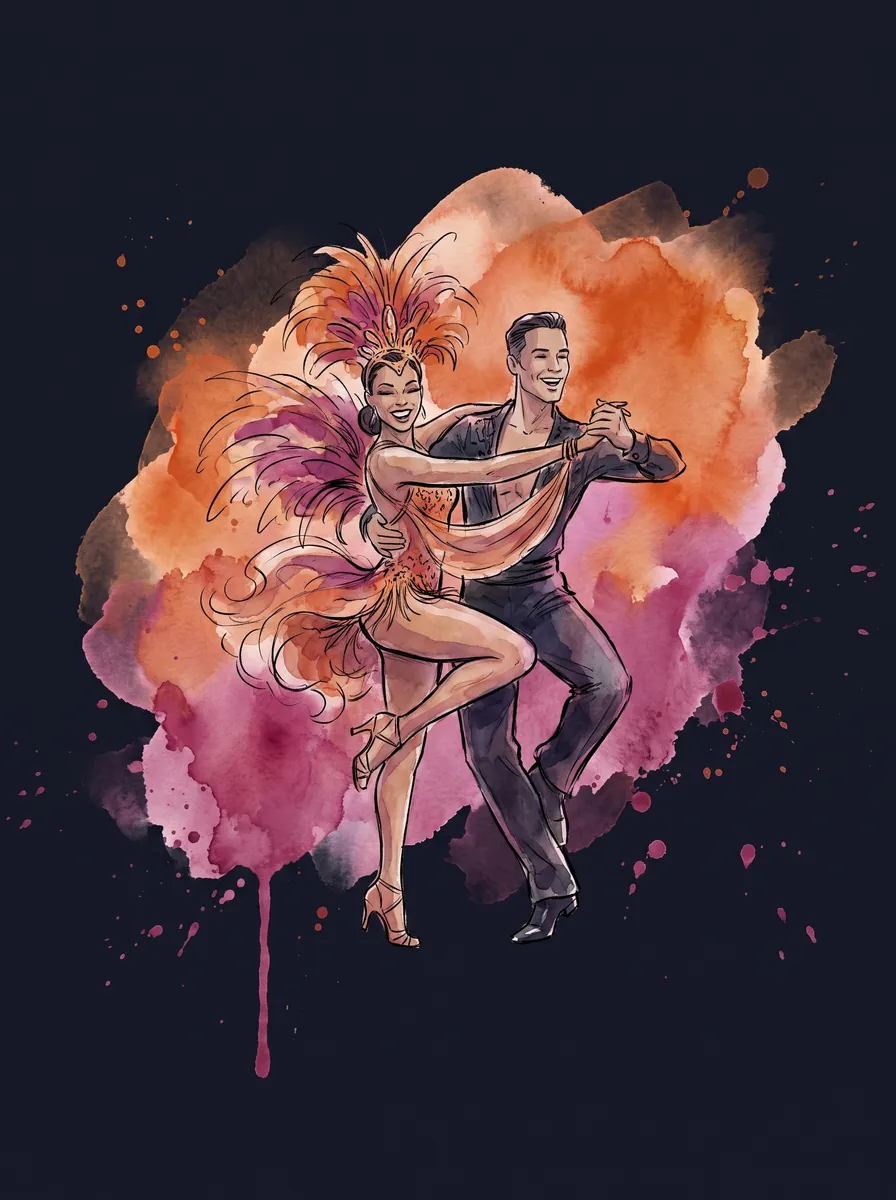
Samba is Brazil's national rhythm — carnival music with African roots, carried into the world's ballrooms in the twentieth century. The version on competition floors is ballroom's partnered adaptation: a travelling dance that bottles the festival and takes it around the room.
Unlike the storytelling rumba or the teasing cha-cha, samba's character is pure celebration — the dance that turns a final into a parade.
How it moves
Everything in samba bounces. The signature action compresses through the knees and ankles on each beat — a grounded, springy pulse counted “1-a-2” — while the couple travels the floor like a carnival procession. Voltas, whisks, and botafogos keep the party moving; done well, the bounce comes from the floor up, never from hopping.
- The samba bounce — knee-and-ankle compression on every beat
- 1-a-2 timing
- Voltas, whisks & botafogos — the travelling vocabulary
- One of the two Latin dances that travel around the floor
What to listen for
A grounded carnival bounce — a springy “1-a-2” with a dropping action.
Test yourself — the Samba rhythm challenge →What judges look for
Judges look at the bounce first — soft, rhythmic compression that stays grounded — and then at travel: samba is a moving dance, and couples who park it lose its character.
Competition tempos are the widely used ranges and vary slightly by federation. New to scoring? Read how ballroom dance judging works.
Songs you can dance the Samba to
Classics and pop staples with the Samba's tempo and feel. Social DJs often run them a touch faster or slower than strict competition tempo — that's normal.
- Mas Que Nada — Sérgio Mendes & Brasil '66
- Magalenha — Sérgio Mendes
- Aquarela do Brasil — Ary Barroso
- Hip Hip Chin Chin — Club des Belugas
- Whenever, Wherever — Shakira
- Copacabana — Barry Manilow
Common questions
- Where does samba come from?
- Brazil — carnival music with African roots. Ballroom samba is the partnered, travelling adaptation danced in competition.
- What is the samba bounce?
- A springy compression through the knees and ankles on each beat — the action that gives samba its festival pulse. It comes from the floor up, not from hopping.
- Does samba travel around the floor?
- Yes — along with the paso doble, it's one of the Latin dances that progress around the room rather than staying on the spot.
Dance it
Learn the Samba near you
1,280 studios across 69 countries teach the world's dances — or watch the Samba competed at a sanctioned event.
The other nine
Which dance are you? Take the quiz · the art of ballroom dance · the history · the glossary