

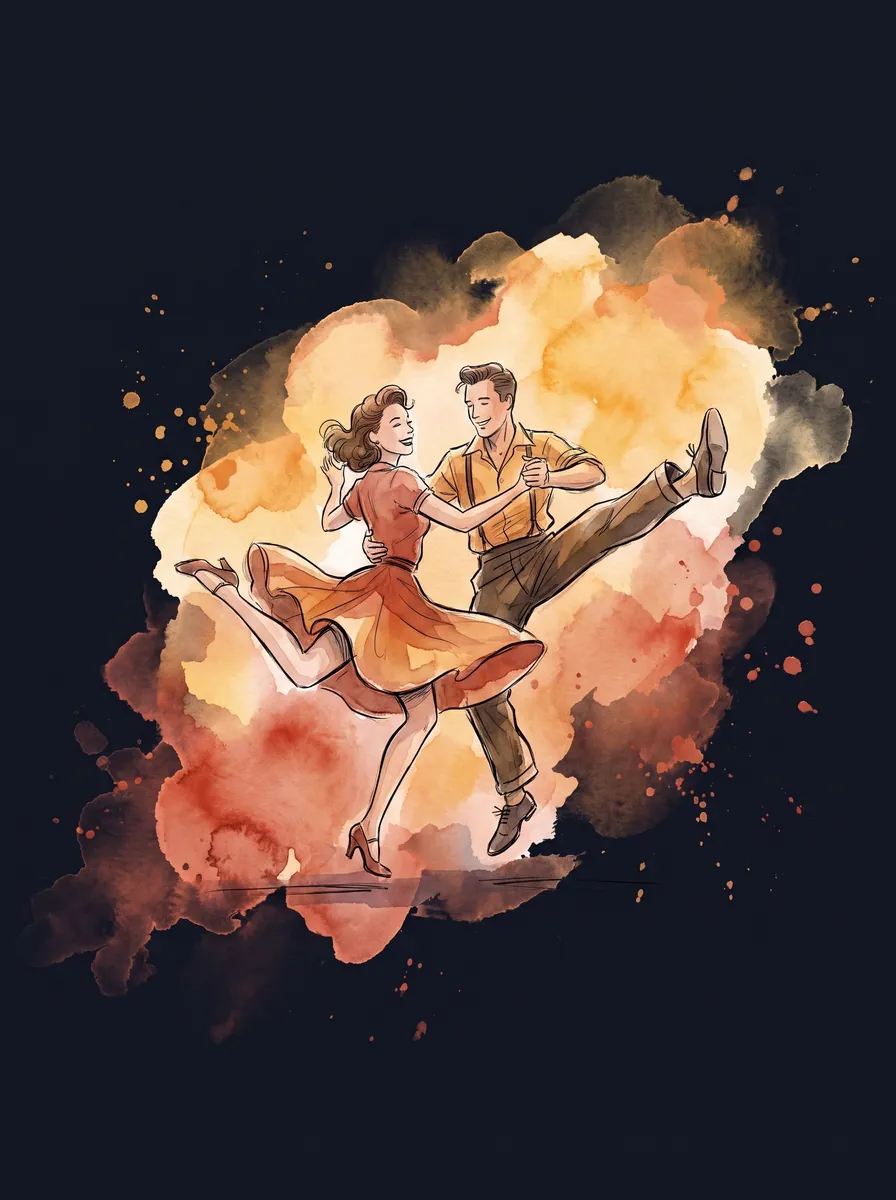
Where it comes from
Jive is ballroom's child of swing. It descends from the Lindy Hop — the African-American innovation born in Harlem's Savoy Ballroom, all acrobatic air steps and dazzling improvisation — which American GIs carried across the Atlantic in the 1940s. English teachers then codified the ballroom version that joined the Latin five.
It customarily closes the Latin section, and for a reason: after four dances, the jive demands the tank's last drop — and looks like pure joy spending it.
How it moves
Jive runs on triple steps — chassés left and right counted “3-a-4” — launched from a rock step, with the kicks and flicks that give the dance its rock-and-roll silhouette. At 42–44 bars a minute it is a stamina test wearing a grin: knees high, feet under the body, bounce sharp but controlled.
- Rock step + triple steps — the engine of the dance
- Kicks and flicks — the rock-and-roll silhouette
- Descended from Harlem's Lindy Hop via wartime swing
- Traditionally the last dance of the Latin five
What to listen for
Rock-and-roll bounce — fast triple-steps that kick and flick.
Test yourself — the Jive rhythm challenge →What judges look for
Judges look for sharpness that survives fatigue — crisp kicks, exact triple steps, and a couple still bouncing on the final bar of the section's most tiring dance.
Competition tempos are the widely used ranges and vary slightly by federation. New to scoring? Read how ballroom dance judging works.
Songs you can dance the Jive to
Classics and pop staples with the Jive's tempo and feel. Social DJs often run them a touch faster or slower than strict competition tempo — that's normal.
- Rock Around the Clock — Bill Haley & His Comets
- Great Balls of Fire — Jerry Lee Lewis
- Johnny B. Goode — Chuck Berry
- Tutti Frutti — Little Richard
- Shake a Tail Feather — Ray Charles
- Footloose — Kenny Loggins
- Marry You — Bruno Mars
Common questions
- What's the difference between jive and swing?
- Same family, different codes: jive is the competitive ballroom form — faster and sharper, with standardized technique — while social swing dances like East Coast Swing and Lindy Hop stay looser and improvised.
- Where does jive come from?
- From Harlem's Lindy Hop by way of wartime swing: American GIs carried the dancing to Europe in the 1940s, and English teachers codified jive as the fifth International Latin dance.
- Why is jive danced last?
- Tradition — and a test. It's the most exhausting of the Latin five, so it closes the section as a final check of stamina, danced at full grin.
Dance it
Learn the Jive near you
1,280 studios across 69 countries teach the world's dances — or watch the Jive competed at a sanctioned event.
The other nine
Which dance are you? Take the quiz · the art of ballroom dance · the history · the glossary