Where it comes from
The tango was born in the immigrant neighborhoods of Buenos Aires and Montevideo, and by the 1910s it had swept Paris and London into full “tango mania” — surviving bans from a Kaiser and a Pope on its way to worldwide fame.
Ballroom tango then went its own way. Standardized in England alongside the other Standard dances, it traded the Argentine original's improvised intimacy for drama at competition scale: a compact hold, a driving march, and the sharpest movement in the ballroom.
How it moves
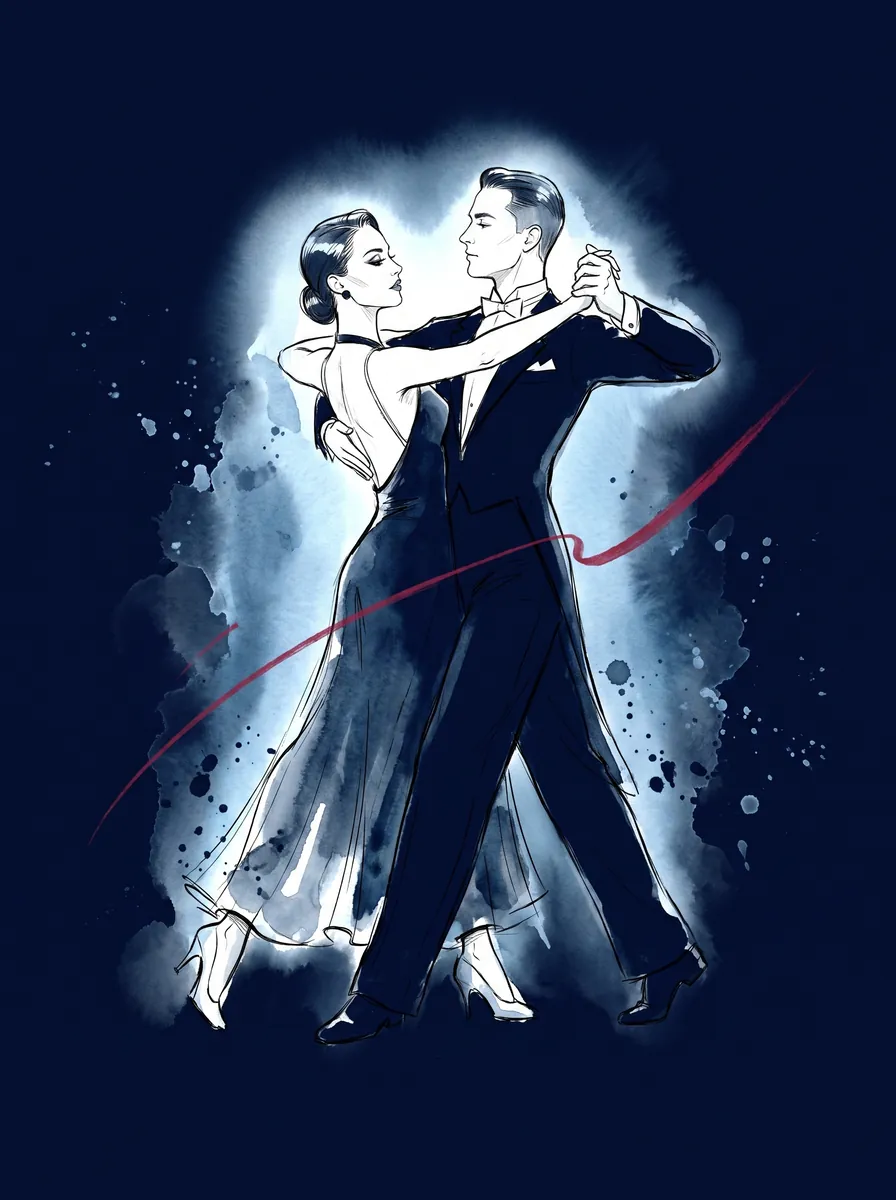
Tango is the Standard dance that doesn't swing. There is no rise and fall — the knees stay flexed, the steps prowl close to the floor, and the movement alternates between cat-like stalking and sudden, absolute stillness. Heads snap where the other dances turn smoothly, and the hold is closer and more compact than in waltz or foxtrot.
- Progressive link & closed promenade — the defining syllabus figures
- Staccato action — sharp steps, no rise and fall
- The head snap — sudden, dramatic changes of direction
- Stalking walks — flexed knees, close to the floor
What to listen for
A staccato march — crisp, marching beats broken by sudden, deliberate stillness.
Test yourself — the Tango rhythm challenge →What judges look for
Judges look for contrast — the discipline to be perfectly still between explosive movements. A tango danced smoothly is a foxtrot in costume; the character lives in the staccato.
Competition tempos are the widely used ranges and vary slightly by federation. New to scoring? Read how ballroom dance judging works.
Songs you can dance the Tango to
Classics and pop staples with the Tango's tempo and feel. Social DJs often run them a touch faster or slower than strict competition tempo — that's normal.
- La Cumparsita — Gerardo Matos Rodríguez
- Por una Cabeza — Carlos Gardel
- Libertango — Astor Piazzolla
- Hernando's Hideaway — from The Pajama Game
- El Tango de Roxanne — from Moulin Rouge!
- Santa María (del Buen Ayre) — Gotan Project
- Whatever Lola Wants — Sarah Vaughan
Also danced in American Smooth
The Tango also appears in American Smooth, the American style danced widely in U.S. competition — same music and character, with its own technique and figures. The differences are covered in how dancesport works.
Common questions
- Is ballroom tango the same as Argentine tango?
- No — they share an ancestor, not a technique. Argentine tango is improvised and intimate; ballroom tango is standardized for competition, with a closer, fixed hold, staccato action, and choreographed drama.
- What makes tango different from the other Standard dances?
- It's the one that doesn't swing: no rise and fall, flexed knees, and sharp, staccato movement where waltz and foxtrot flow.
- What time signature is ballroom tango?
- 2/4, danced at about 31–33 bars per minute — and counted in slows and quicks rather than numbers.
Dance it
Learn the Tango near you
1,280 studios across 69 countries teach the world's dances — or watch the Tango competed at a sanctioned event.
The other nine
Which dance are you? Take the quiz · the art of ballroom dance · the history · the glossary