

Where it comes from
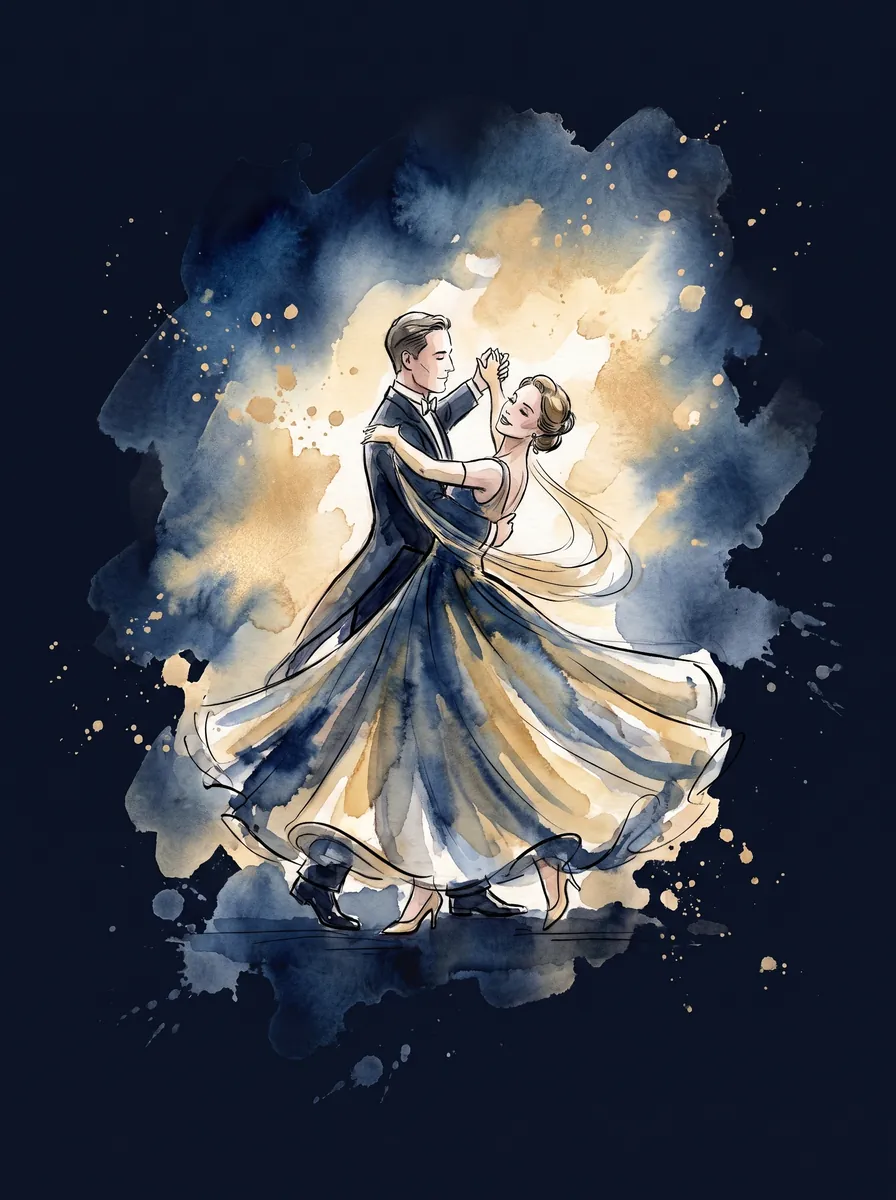
This is the original waltz — the dance that scandalized Europe when partners first embraced and spun around 19th-century ballrooms. The Strauss family, above all Johann Strauss Jr. and The Blue Danube, turned it into a craze that filled Vienna's grand public dance halls and let the classes mingle as never before.
When English teachers slowed the waltz down in the 1920s, the fast original kept its own place on the competition floor under the city's name. It remains the ballroom's most direct line to the 19th century: what a Viennese Waltz final shows you is, at heart, what Vienna saw.
How it moves
The Viennese Waltz is nearly all rotation. At 58–60 bars a minute there is no time for elaborate figures — couples turn continuously down the line of dance, alternating natural (right-turning) and reverse (left-turning) turns, with change steps to switch between them and the fleckerl spinning on the spot at the floor's center. It is the fastest Standard dance, and among the most physically demanding.
- Natural & reverse turns — the dance is built from them
- Change steps — the bridge between turning directions
- The fleckerl — spinning in place at the center of the floor
- Nearly double the slow waltz's tempo
What to listen for
The same 3/4 lilt as the waltz — but whirling, at nearly double the speed.
Test yourself — the Viennese Waltz rhythm challenge →What judges look for
With so few figures, there is nowhere to hide — judges watch the quality of the turn itself: even rotation, steady sway, and a couple that stays calm and upright at speed.
Competition tempos are the widely used ranges and vary slightly by federation. New to scoring? Read how ballroom dance judging works.
Songs you can dance the Viennese Waltz to
Classics and pop staples with the Viennese Waltz's tempo and feel. Social DJs often run them a touch faster or slower than strict competition tempo — that's normal.
- The Blue Danube — Johann Strauss II
- Masquerade Waltz — Aram Khachaturian
- Kiss from a Rose — Seal
- A Thousand Years — Christina Perri
- Iris — Goo Goo Dolls
- Shall We Dance? — from The King and I
- Delilah — Tom Jones
Also danced in American Smooth
The Viennese Waltz also appears in American Smooth, the American style danced widely in U.S. competition — same music and character, with its own technique and figures. The differences are covered in how dancesport works.
Common questions
- How fast is the Viennese Waltz?
- About 58–60 bars per minute — nearly twice the tempo of the slow waltz, which makes it the fastest of the Standard dances.
- Why is it called the Viennese Waltz?
- It's the original 19th-century waltz as danced in Vienna's grand ballrooms — kept at its historic tempo when English teachers slowed the modern waltz down in the 1920s.
- Is the Viennese Waltz hard to learn?
- The step vocabulary is small — mostly turns and change steps — but the speed demands stamina and balance. Most dancers come to it after the slow waltz.
Dance it
Learn the Viennese Waltz near you
1,280 studios across 69 countries teach the world's dances — or watch the Viennese Waltz competed at a sanctioned event.
The other nine
Which dance are you? Take the quiz · the art of ballroom dance · the history · the glossary