

Where it comes from
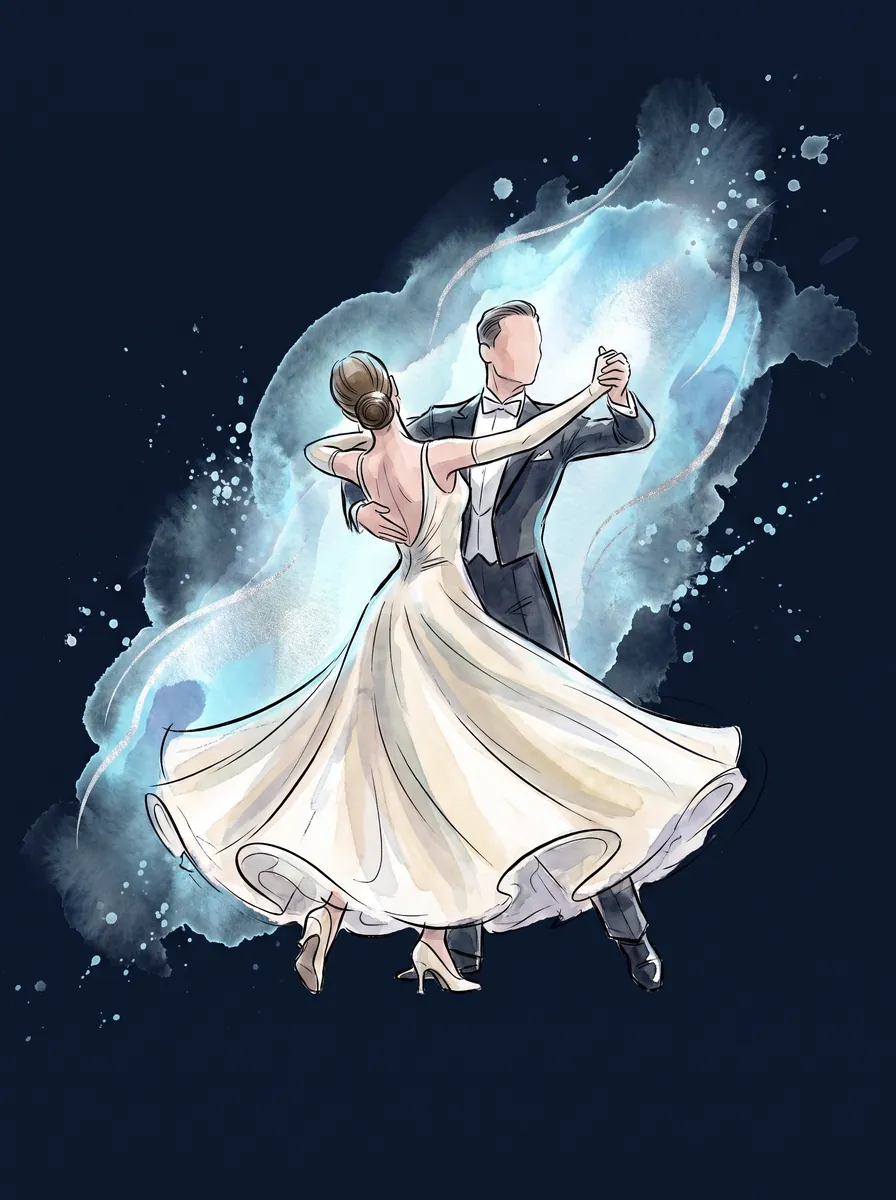
The waltz began as a scandal. Evolving from the Austrian and German folk Ländler, it introduced something ballrooms had never seen: the closed couple hold — partners embracing and turning together around the room. Moralists called it risqué, doctors warned the spinning was dangerous, and the controversy only made it irresistible.
The whirling original lives on as the Viennese Waltz. The dance on this page — the slow waltz — took shape in England in the 1920s, when teachers standardized a gentler tempo and the rise-and-fall technique that gives the modern dance its breath. It has opened formal balls, wedding first dances, and championship finals ever since.
How it moves
Everything in the waltz swings. Couples travel counter-clockwise around the floor in 3/4 time, rising through the feet and knees at the top of each bar and lowering softly into the next — the rise and fall that makes good waltzing look like breathing. The body sway through the turns — borrowed, tellingly, from the Cuban rumba — keeps the rotation smooth rather than mechanical.
- Box step & natural turn — the first figures every beginner learns
- Rise and fall — lift through beat 1, float through 2, lower on 3
- Whisk & chassé — the classic syllabus pair
- Sway — the body's inclination through the turns
- The classic wedding first dance
What to listen for
A clear lift on beat 1, then float through 2 and 3 — the gentle rise-and-fall swing.
Test yourself — the Waltz rhythm challenge →What judges look for
Judges reward the swing: soft knees, seamless rise and fall, and turns that flow without visible effort. A waltz that hurries — stepping flat, snatching the rise — reads instantly from the judges' table; the best couples make thirty bars a minute look unhurried.
Competition tempos are the widely used ranges and vary slightly by federation. New to scoring? Read how ballroom dance judging works.
Songs you can dance the Waltz to
Classics and pop staples with the Waltz's tempo and feel. Social DJs often run them a touch faster or slower than strict competition tempo — that's normal.
- Moon River — Henry Mancini / Audrey Hepburn
- Tennessee Waltz — Patti Page
- Que Sera, Sera — Doris Day
- Are You Lonesome Tonight? — Elvis Presley
- Edelweiss — from The Sound of Music
- Sunrise, Sunset — from Fiddler on the Roof
- Dark Waltz — Hayley Westenra
Also danced in American Smooth
The Waltz also appears in American Smooth, the American style danced widely in U.S. competition — same music and character, with its own technique and figures. The differences are covered in how dancesport works.
Common questions
- What time signature is the waltz?
- 3/4 — three beats to a bar, danced at roughly 28–30 bars per minute in competition. The dancer's count is a simple 1-2-3.
- What is the difference between the Waltz and the Viennese Waltz?
- Speed, mostly. The Viennese Waltz is the fast, whirling original at nearly double the tempo, built almost entirely from turns; the slow waltz has a larger vocabulary of figures and the signature rise and fall.
- Is the waltz a good first dance to learn?
- Yes — the box step can be learned in a single lesson, and the slow tempo leaves time to think. It's a staple of wedding first dances for exactly that reason.
- Is the waltz danced in American Smooth?
- Yes. American Smooth waltz shares the music and character but allows the partners to open the hold — side-by-side positions and solo turns that International Standard doesn't permit.
Dance it
Learn the Waltz near you
1,280 studios across 69 countries teach the world's dances — or watch the Waltz competed at a sanctioned event.
The other nine
Which dance are you? Take the quiz · the art of ballroom dance · the history · the glossary